End of Days (hazy IPA)
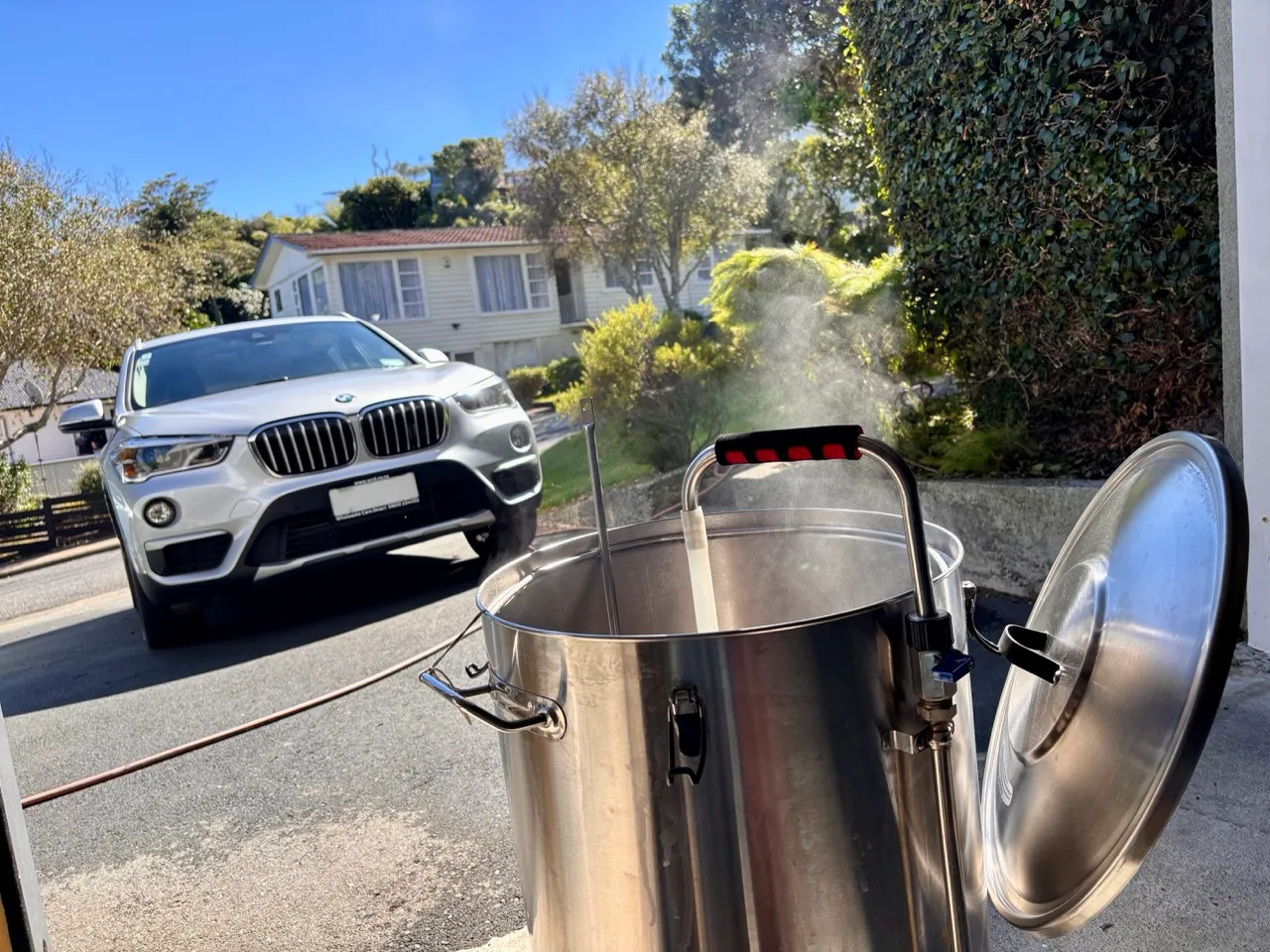
I’m currently brewing a beer, as it was sunny today, I had a day off from work and some ingredients to brew with.
Why “End of Days”
- It’s coming up to the end of Summer in New Zealand
- The world is in a bit of peril at the moment, and it feels like doom and gloom
- It rhymes with Haze, as in Hazy (IPA)
It’s my first actual proper attempt at a Hazy IPA, or NEIPA (New England IPA).
I say proper because I’ve attempted it before, with little success because I didn’t have the right equipment.
For a successful NEIPA, you need to limit the amount of oxygen the beer touches. The best way to do this is to push the beer from the fermenter into the keg with CO2.
Recently I bought a small, but expensive kit for my SS brewtech Brew Bucket.
It was a bit of a challenge to work out exactly what pieces of equipment I needed.
The equipment
- SS Brewtech Brew Bucket
- SS Brewtech domed lid for brew bucket
- SS Brewtech pressure transfer kit
- 10mm hose
- 8mm hose
- splicer joiner 3/16” x 1/4”
- CO2 bottle
- Fridge
- Heatpad
- Temperature controller
- Sanitiser
- Grainfather S40
- Brew In a Bag bag
Learnings from previous brew day
The previous beer I made was a recipe I made with the help of Chat GPT.
It turned out awful. Not exactly sure, what went wrong, but the beer was very bitter and had some funky off flavours.
I may have added the yeast while the wort was still quite warm.
When trying to push the beer into the keg, I had a lot of trouble and felt I needed to use a lot of pressure.
I was worried the fermenter could explode, and thought that something was not right.
It wasn’t.
I didn’t open the keg’s pressure relief valve. Always open the PRV when transferring beer!
The recipe
I went with New Zealand ingredients where I could.
To prevent chlorine spoilage, I use one crushed-up campden tablet.
I chose Verdant yeast by LalBrew.
It’s a 23l batch, ideally for a full 19l corny keg.
Fermentables
| Ingredient | Amount |
|---|---|
| Gladfield ale | 3.9kg |
| Gladfield wheat | 0.8kg |
| Gladfield “Big O” | 0.6kg |
| Glafield chit | 0.3kg |
| Brick Road DME | 0.5kg |
| Lactose | 0.1kg |
Hop schedule
Boil
| Hop | Timing (from boil start) | Amount |
|---|---|---|
| Cascade | 30mins | 12g |
| Luminosa | 15mins | 12g |
| Citra | 10mins | 12g |
| Cascade | 0mins | 12g |
Hop stand (80˚c)
| Hop | Length of time | Amount |
|---|---|---|
| Cascade | 10mins | 40g |
| Luminosa | 10mins | 40g |
Dry hop (on day 4)
| Hop | Amount |
|---|---|
| Cascade | 36g |
| Luminosa | 36g |
| NZH-105 | 50g |
| Citra | 50g |
Process
I filled the Grainfather up with 25l of tap water.
Normally I use the houses built-in filter, but I damaged my shoulder recently so can’t carry heavy things up and down from the back of the house.
The tap water is fine though, I just added a campden tablet to remove any chlorine taste.
Once the temperature got to 68˚c, I added the grains and stirred making sure to remove any clumps/doughballs.
Mashed for 60mins, then turned up the temperature on the Grainfather to 103˚c.
Once boiling, I waited for 30mins until the first addition.
Towards the end, with 10 minutes to go, I added 100g of lactose, to help with mouth-feel, or the creamy-viscosity that is pleasant.
Once all the boil and hop-stand hops were complete, I set the emersion chiller do it’s job.
It took over an hour to cool down to about 36˚c, by that time I had santised the fermenter and used a santised strainer to help with filtering out any clumps of hops or protein.
Still too hot to pitch the yeast, I put the fermenter into the fridge and set the temperature to 17.6
I want a temperature of around 19˚c so keeping it lower is safer than directly setting it to 19˚c where it could make the yeast go crazy and splurt out flavours that aren’t nice.
After a few hours, I checked the temperature and it was just under 19˚c so pitched the yeast.
Hopefully this beer will be complete before the end of days 😂
—— Yeehaw!